Showing posts with label Clipper. Show all posts

Tuesday, 11 December 2012

Constructing the Airstream


      The earliest designs of the Clipper from the 1930s already boast of the most advanced heat insulation and ventilation systems. In addition to electric lights, Airstreams even came with their own dry-ice air conditioning system. 

      The current Clipper design uses two aluminum shells with a layer of insulation sandwiched in between. The layer of insulation consists of a 2-inch temperature resistant mattress of aerocore fiberglass that's impervious to flame, vermin, water, and settling. This allows for cool temperatures in the summer, and warmer temperatures in the winter. 

Structural member of the trailer body being wired

                                                          Fitting the insulation into the walls

      The central door of the Clipper has a part that can be opened to turn the door into a screen for added ventilation. Instead of nails and screws which might dislodge overtime from excessive road wear, each Clipper is constructed with thousands of rivets. Each rivet alone requires two skilled mechanics to drive into the Clipper's body. One can only imagine how much time and effort was required for the completion of each trailer. 

In essence, every square inch of the Airstream Clipper was designed for a functional purpose.

"Let's not make any changes - let's make only improvements"

Over the years, Wally Byam adopted this phrase as the motto for his Airstream Company. As demonstrated by the iconic silver aluminum of the Clipper's exterior shell, Wally made changes to his designs only when he found it absolutely beneficial to the function of the trailer. Consequently, the aesthetics of the trailer underwent minimal changes over the course of its lifetime. Five major body changes later, the aluminum shell of the first 1936 Clipper is still on the roads.

Just as Wally Byam wished, the company made nothing but improvements. Wally's experience in aircraft during the war led to the development of the dura-torque axle running gear. Its installation in the trailer eliminated 148 extraneous parts, absorbed bumps, and reduced slipping and side-sway. Additionally, it increased ground clearance by 8 inches and minimized the need to lubricate the axle assembly. Before 1957, the Clipper had 13 metal sections on either ends. In more recent designs, the sections were widened, reducing their number to just 7. By flattening the underside of the belly, Wally also reduced the Clipper's wind resistance. He also installed an 18 by 40 inch window at the back of the trailer in case the side door was jammed.


                                                      1957 Airstream Clipper with the rear-window


Throughout his career, Wally Byam scoured the world for new inventions and innovations that would improve the functionality and livability of the Airstream Clipper. Things as small as door hinges and as large as toilets, hot water heaters, and porcelain sinks were all on Wally's agenda. If Wally were still alive, much of his time would undoubtedly be spent in the aisles of Home Depot, searching for any small piece that might improve the Airstream. After a visit to Europe, Wally Byam found a heating system that provided radiant heat without taking up much space. He borrowed the idea to create his own heating system, which he later renamed the Byam Burner. In France, he found a compact refrigerator which replaced the inefficient ice-boxes that were once found in the early Clippers. Hot water systems and steam-pressured flush toilets are just a few of the other things that Wally brought to the Airstream over the years.

"Let's not make any changes -  let's make only improvements."

Airstream Axonometric


Airstream Clipper Side Elevation


Airstream Clipper Front Elevation


Airstream Clipper Interior Plan


Airstream Clipper Frame Plan


Airstream Clipper Interior Section


Sunday, 9 December 2012

Airstream Purists

      To many Airstream enthusiasts, the Clipper is known as 'Granddad'. Contrary to what one might assume, this name was coined out of respect and adoration for the vehicle, rather than ridicule and mockery over its age. After all, the Airstream has only undergone five major body changes since 1936, and none of these alterations had any affect on the iconic aluminum shell of the Airstream trailer. Over the years, the Airstream designs have been changed to accommodate larger interior spaces and improve ease of towability, but the reputable aluminum casing that surrounds the Airstream's exterior is just as lustrous and round now as its first model. It's no wonder, then, that people have developed a particular fondness for the iconic Airstream look. In fact, any models that deviate from these aesthetics are heavily condemned by the purist community.


Airstream Clipper '36

      In 1989, an Airstream Land Yacht was released in a beige colour with a sawed-off, square-ish front. Not surprisingly, the trailer was quickly dubbed the 'Squarestream', which -- unlike the 'Granddad' -- was not at all endearing. To say the least, it wasn't one of their most popular products.


                                                                     The 'SquareStream'

      Later on, Airstream released a trailer named 'Integrity' with a fifth wheel attached to an additional axel. Anyone who was unfortunate enough to be seen traveling in this trailer was dubbed the 'Tupperware Trailer'.


Integrity, a.k.a. 'Tupperware Trailer'


Sources:
Burkhart, Bryan, and David Hunt. Airstream: The History of the Land Yacht. San Francisco: Chronicle, 2000. Print.

The 1936 Airstream Clipper

 Streamlined Car

      The streamline style of the 1930s was a result of the Art Deco style that originated in Paris in the 20s.  This sleek, simple modern look was used widely in the designs of cars, furniture, and of course the iconic Airstream Clipper trailer.  William Hawley Bowlus was one of the first builders of the streamlined trailers.  He was the first to produced the aluminum Road Chief trailer that was shaped like an airplane fuselage.  


Road Chief 

      After Bowlus' company went bankrupt in 1936 Byam purchased some of his equipment and hired a number of his employees and redesigned Bowlus' trailer into the Airstream Clipper.  Byam installed roll-up windows and moved the door of the trailer to the side which allowed for the front edges to disappear.  He also moved the chassis between the wheels and raised the covers for a larger interior.  Today only a handful of Clippers remain but the look and feel of past and current Airstreams all originated from the original design.


Airstream Clipper


Sources:
Lopez Cotelo, B. "Airstream Clipper." Tectonica Blog, 21 January 2010. Web. 5 Nov 2012. <http://tectonicablog
      .com/?p=4470>.
Strongman, Tom. "1936 Airstream Clipper." Tom Strongman's Auto Ink, 17 September 2012. Web. 9 Dec. 2012. 
      <http://tomstrongman.com/1936-airstream-clipper-3/>.

The Interstate's Impact on the Clipper

      The booming popularity of the Airstream Clipper following WWII can easily be attributed to the creation of the Interstate Highway System in the United States. The Airstream Clipper had been popular since its conception in 1936, but it wasn’t until 1948 that the demand for the trailer shot up tremendously. The Airstream Company was forced to relocate their facilities to a larger factory in Jackson Center, Ohio in order to meet their customers’ needs.


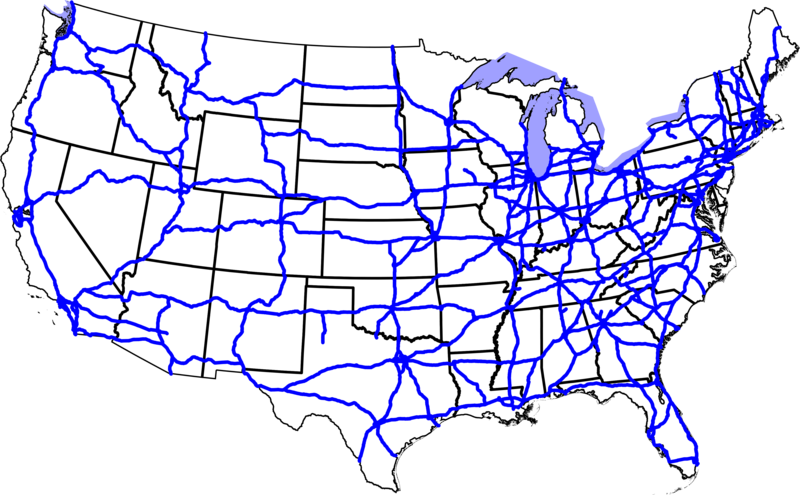
      With a total length of 75 932 km, the Interstate is truly an impressive work of engineering that spans across and connects all of the United States. Before this expansive network existed, the most preferred method of travelling across the country was the transcontinental railway. Not only did the introduction of the Interstate shift the American population from the railway to the road, but it also revolutionized the idea of travelling. Now that the entire country was connected by this network of roads, traveling destinations were no longer limited to the urban areas around train stations. You could essentially travel wherever you wanted (provided it was accessible by the 75 932 km highway system), and you could do all of this within the comfort of your own (second and temporary) home.


      Airstreams were very much designed to travel on the highway. They were never intended to remain stationary in any one place. Rather, just as Wally had intended when he designed the trailer in 1936, the Airstream was meant to be a traveling home for the adventurous highway driver.

After all:

“Why the name ‘Airstream’? Because it rode along the highway, ‘like a stream of air’”
                                                                                                                 
                                                                                                                                       - Bryan Burkhart and David Hunt (Airstream, p. 34)


Sources:
Burkhart, Bryan, and David Hunt. Airstream: The History of the Land Yacht. San Francisco: Chronicle, 2000. Print.
"The Economic Impact of the Interstate Highway System." Interstate 50 Years. Ed. Andrew C. Lemer. N.P., 2006. Web.
      9 Dec. 2012
"History." Airstream, Inc. Airstream, Inc., n.d. Web. 14 Nov 2012. <http://www.airstream.com/company/history/>


Thursday, 6 December 2012

Hawley Bowlus' Road Chief

Hawley Bowlus's "Road Chief", the original riveted aluminum trailer. The company was purchased by Byam and later redesigned into the original Clipper by making minor modifications such as moving the door from the back to the middle.

Wednesday, 5 December 2012

Table 2: Aluminum production and its relation to Airstream Clipper

From this spreadsheet, it shows that the airstream clipper (1936) was manufactured when the aluminum production was doubled from the previous year. Also, the low unit value of aluminum in the late 1930's and 1940's may have contributed to the choice in material of the airstream clipper.


Sources:
"Aluminum Statistics." USGS. N.p., 2005. Web. 5 Nov 2012. <http://minerals.usgs.gov/ds/2005/140/aluminum.pdf>.

Airstream's Location


A map of the US Interstate system, the home of the Airstream Clipper

      Since the Clipper is a mobile home, it's location cannot be pinpointed to any one spot. Rather, its primary location could be counted as anywhere along the highway, particularly the Interstate Highway System in the United States. 

      After President Dwight Eisenhower signed the Federal-Aid Highway Act in 1956, plans were immediately developed to create a 41,000 mile highway system. According to Eisenhower, the highway would not only eliminate unsafe roads, inefficient routes and traffic congestion, but also act as a national defense system in case of an atomic attack on any major American city. He was convinced the road network would allow for a quick evacuation from target areas.  In spite of Eisenhower's justifications, however, many people believed that the development of the Interstate was motivated by automobile manufacturers who had lobbied for free roads since the beginning of cars. 

      Additionally, the invention of the Interstate significantly boosted the American economy. While industries were once limited to the boundaries of urban areas, the Interstate allowed them to expand and grow. The value of land was also increased as rural areas became accessible via the highway. Consequently, the Interstate contributed largely to urban sprawl and enabled the development of suburbs. Not everyone was pleased with the rise of the automobile and respective decline of the train. While rail unified the nation, the Interstates have nurtured what one might call 'the geography of nowhere' we're familiar with today. Most of America is homogeneously spread across a wide expanse of land, peppered with the same old strip malls, chain restaurants and big-box stores. The view is unchanged regardless of where you are on the Interstate. 


Sources:
Burkhart, Bryan, and David Hunt. Airstream: The History of the Land Yacht. San Francisco: Chronicle, 2000. Print.
"The Economic Impact of the Interstate Highway System." Interstate 50 Years. Ed. Andrew C. Lemer. N.P., 2006. Web.
      9 Dec. 2012

Airstream Clipper Section