Showing posts with label Wally Byam. Show all posts

Tuesday, 11 December 2012

"Let's not make any changes - let's make only improvements"

Over the years, Wally Byam adopted this phrase as the motto for his Airstream Company. As demonstrated by the iconic silver aluminum of the Clipper's exterior shell, Wally made changes to his designs only when he found it absolutely beneficial to the function of the trailer. Consequently, the aesthetics of the trailer underwent minimal changes over the course of its lifetime. Five major body changes later, the aluminum shell of the first 1936 Clipper is still on the roads.

Just as Wally Byam wished, the company made nothing but improvements. Wally's experience in aircraft during the war led to the development of the dura-torque axle running gear. Its installation in the trailer eliminated 148 extraneous parts, absorbed bumps, and reduced slipping and side-sway. Additionally, it increased ground clearance by 8 inches and minimized the need to lubricate the axle assembly. Before 1957, the Clipper had 13 metal sections on either ends. In more recent designs, the sections were widened, reducing their number to just 7. By flattening the underside of the belly, Wally also reduced the Clipper's wind resistance. He also installed an 18 by 40 inch window at the back of the trailer in case the side door was jammed.


                                                      1957 Airstream Clipper with the rear-window


Throughout his career, Wally Byam scoured the world for new inventions and innovations that would improve the functionality and livability of the Airstream Clipper. Things as small as door hinges and as large as toilets, hot water heaters, and porcelain sinks were all on Wally's agenda. If Wally were still alive, much of his time would undoubtedly be spent in the aisles of Home Depot, searching for any small piece that might improve the Airstream. After a visit to Europe, Wally Byam found a heating system that provided radiant heat without taking up much space. He borrowed the idea to create his own heating system, which he later renamed the Byam Burner. In France, he found a compact refrigerator which replaced the inefficient ice-boxes that were once found in the early Clippers. Hot water systems and steam-pressured flush toilets are just a few of the other things that Wally brought to the Airstream over the years.

"Let's not make any changes -  let's make only improvements."

Wally Byam's Travel Philosophy

"Adventure is where you find it, any place, every place, except at home in the rocking chair"                        - Wally Byam                                                                                                                              


      Wally Byam believed in adventure. He believed that the trailer should be used as a mode of transportation and travel rather than a stationary home. He believed that everyone - even those who hated to leave home - should tap into their sense of adventure and go out onto the highway in search of new experiences. His dream for the Airstream Company was to create a lifestyle in which people could do so without leaving the comforts of their home. In fact, he didn't think that anyone should ever stop traveling, so long as they were physically capable of it. Wally believed that there was something to be found and to be seen anywhere in the world, even in places that weren't too far from home at all. When asked by one of the caravanners what they should do while he's in the hospital, he said:

"Don't stop. Keep right on going. Hitch up your trailer and go to Canada or down to Old Mexico. Head for Europe, if you can afford it, or go to the Mardi Gras. Go someplace you've heard about, where you can fish or hunt or collect rocks or just look up at the sky. Find out what's at the end of some country road. Go see what's over the next hill, and the one after that, and the one after that."


To Wally, trailer travel provided their owners with freedom - four freedoms, to be exact, that he laid out in Trailer Travel. 


  1. Freedom from arrangements - reservations, schedules, taxis, tips. "You don't have to worry about reservations in the next town or where you are going to sleep that night. You have all your accommodations right there with you. Home is where you stop."
  2. Freedom from the problems of age - "For some, checkers, clubs, gardening, and grandchildren is not enough. Out of this boredom, ailments are born."
  3. Freedom to know - "You meet people on a train or a plane and the next day you separate. When you travel in a trailer, you meet people in their homes and they meet you in theirs."
  4. Freedom for fun - "To relax and lose yourself mentally."
                                                                                                    (Airstream, p.42)


"To place the great wild world at your doorstep, for you who yearn to travel with all the comforts of home"

                                                                                                           - Wally Byam


Sources:
Burkhart, Bryan, and David Hunt. Airstream: The History of the Land Yacht. San Francisco: Chronicle, 2000. Print.

The Trailer as a Permanent Address

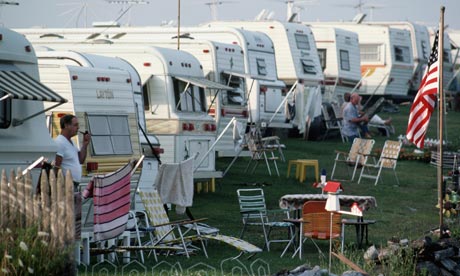
      Over the years, Wally’s idealistic vision of the Airstream as a traveling home has been buried under the negative views portrayed by popular culture. Today, the term ‘trailer’ conjures up a variety of images, none of which are – unfortunately – related to the iconic Clipper or any of Wally Byam’s Airstream legacies. All of these connotations were initiated by the idea of transforming one’s mobile home into a primary home – in other words, a permanent address. As the movement continued to grow, the picture of freedom and mobility that once surrounded the Airstream was steadily replaced by a string of stereotypes that branded trailer-dwellers as ‘rootless hobos’ and ‘homeless gypsies’.


“Small men, most of them, mousetrap makers startled by the customers banging at their doors, they have no exalted ideas about converting homeowners to nomadism…They want the trailer to be a vehicle, not a permanent address”
-        Fortune Magazine [about Wally Byam]

      Wally had never intended for his trailers to become permanent addresses. In fact, despite the potential he saw for sales amongst people like cotton pickers, wheat harvesters, mechanics and factory workers who migrated from job to job, he highly discouraged the notion of ‘living’ in a trailer. Nevertheless, many war-time couples who wed during the war turned to Airstream Clippers for temporary housing. Moreover, a surplus of university students was housed in the Clippers when no other residences could be found to accommodate them. It seemed that Wally’s voice in the issue was quickly overcome by the demand for affordable and mobile housing.

      Most trailers in the 1930s provided all that was necessary in a home – a small toilet, a kitchen, a bed, etc. However, people still needed a place to stop and rest at the end of the day. Consequently, gas station owners would wait for tired trailer owners and charge them 25 cents a day to plug into their electricity and have access to tap water. In this way, the first informal trailer parks were born. Some people simply never got back on the road. For others, not having a permanent address was a clever way of evading tax collectors and landlords. Most impressively, living in a trailer cost only $65 a month. Public opinion quickly turned against these trailer parks; many people were distrustful of them and believed that they would cause a great menace within the justice system with all the new laws that would have to be created for their regulation.  


      Wally Byam was aware of the buzz that surrounded his beloved creation. He once said, “We are determined to improve our public image, as the boys on Madison Avenue say, so that people change their absurd notion that we are homeless gypsies.” Unfortunately, the negative associations with trailers have only worsened since his death. Wally’s picture-perfect vision of a traveling home never returned to the popularity it experienced when the Clipper was first introduced. 


Sources:
Easterling, Keller. Organization Space: Landscapes, Highways, and Houses in America. Cambridge, MA:MIT, 1999. 
      Print.

Sunday, 9 December 2012

The 1936 Airstream Clipper

 Streamlined Car

      The streamline style of the 1930s was a result of the Art Deco style that originated in Paris in the 20s.  This sleek, simple modern look was used widely in the designs of cars, furniture, and of course the iconic Airstream Clipper trailer.  William Hawley Bowlus was one of the first builders of the streamlined trailers.  He was the first to produced the aluminum Road Chief trailer that was shaped like an airplane fuselage.  


Road Chief 

      After Bowlus' company went bankrupt in 1936 Byam purchased some of his equipment and hired a number of his employees and redesigned Bowlus' trailer into the Airstream Clipper.  Byam installed roll-up windows and moved the door of the trailer to the side which allowed for the front edges to disappear.  He also moved the chassis between the wheels and raised the covers for a larger interior.  Today only a handful of Clippers remain but the look and feel of past and current Airstreams all originated from the original design.


Airstream Clipper


Sources:
Lopez Cotelo, B. "Airstream Clipper." Tectonica Blog, 21 January 2010. Web. 5 Nov 2012. <http://tectonicablog
      .com/?p=4470>.
Strongman, Tom. "1936 Airstream Clipper." Tom Strongman's Auto Ink, 17 September 2012. Web. 9 Dec. 2012. 
      <http://tomstrongman.com/1936-airstream-clipper-3/>.

Thursday, 6 December 2012

Wally Byam

      Wallace Byam, born July 4, 1896 in Baker City, Oregon, was the inventor of the Airstream Clipper, one of the first travel trailers. From a very young age, Wally enjoyed travelling with his grandfather on long trips. As a young man, he was a shepherd, living in a cart with a cook stove, sleeping bag and wash tub. Becoming a magazine publisher, in the late 20s sold sets of plans for a do-it-yourself travel trailer for $5 as well as complete kits and fully-assembled models he built in his back yard. After being involved in the sale of the Bowlus "Road Chief", Byam founded Airstream Co. and bought The Bowlus Company in 1935 and started re-marketing their flagship trailer, slightly modified, under a different name. Thus, the Clipper was born.

      Airstream Co. was the only travel trailer company to survive the Great Depression. On the onset of World War II, Byam stopped the production of Airstream models and used his experience in aluminum fabricating in the aircraft industry. When the war ended, Byam re-opened his doors and the production of Airstream trailers hasn't stopped since.

Wally Byam died at the age of 66 on 22 July, 1962 of a brain tumour.


Sources:
"History." Airstream, Inc. Airstream, Inc., n.d. Web. 14 Nov 2012. <http://www.airstream.com/company/history/>

Wednesday, 5 December 2012

Wally Byam Caravan Club International

Although most Airstream owners are passionate travellers many of them were intimidated by the idea of travelling alone.  Wally had noticed that many of the buyers were just letting their trailers sit in the front yard and decided to round up a group of fellow Airstreamers for a caravan.  The first Airstream caravan left in 1951 and travelled to many parts of Central America including Guatemala, El Salvador, Mexico, Honduras and more.  The group eventually grew into the "Wally Byam Caravan Club Internation" (WBCCI) and became one of the largest RV owners club in the world.  At one point the club had became so popular that Wally had to limit the amount of participants to only Airstream owners.

The WBCCI first began touring most of North and Central America and eventually all around the world.  The famous Cape Town to Cairo Caravan began in 1959 in Africa and had included over a hundred participants.  Caravaner enthusiasts gathered from all over on this excursion to see the pyramids and deserts of Central and Northern Africa.  And in 1964 the club set out for Singapore, tracing the silk route originally taken by Marco Polo and travelled 35 000 miles in over a year and visited almost every country in Southern Asian, Europe, and the Soviet Union.


Soon the Airstream became one of the most internationally recognized trailers in the world, spotted in many famous sites and photographs from all around the world.  After Wally's death in 1962 the WBCCI continued and grew to be one of today's leading caravans in Northern and Central America.


Sources:
"Fast Facts." Airstream, Inc. Airstream, Inc., n.d. Web. 14 Nov 2012. <http://www.airstream.com/comp
      any/fast-facts/>
"History." Airstream, Inc. Airstream, Inc., n.d. Web. 14 Nov 2012. <http://www.airstream.com/company
      /history/>
Reasons, Don. "The Airstream Web Ring." The Airstream Web Ring, n.p., n.d. Web. 14 Nov 2012. 
      <http://sd2cx1.webring.org/l/rd?ring=airstream;id=50;url=http%3A%2F%2Fwww%2Ecalldon%2Ec
      om%2Fair%2Ehtm>