Showing posts with label lifestyle. Show all posts

Tuesday, 11 December 2012

Wally Byam's Travel Philosophy

"Adventure is where you find it, any place, every place, except at home in the rocking chair"                        - Wally Byam                                                                                                                              


      Wally Byam believed in adventure. He believed that the trailer should be used as a mode of transportation and travel rather than a stationary home. He believed that everyone - even those who hated to leave home - should tap into their sense of adventure and go out onto the highway in search of new experiences. His dream for the Airstream Company was to create a lifestyle in which people could do so without leaving the comforts of their home. In fact, he didn't think that anyone should ever stop traveling, so long as they were physically capable of it. Wally believed that there was something to be found and to be seen anywhere in the world, even in places that weren't too far from home at all. When asked by one of the caravanners what they should do while he's in the hospital, he said:

"Don't stop. Keep right on going. Hitch up your trailer and go to Canada or down to Old Mexico. Head for Europe, if you can afford it, or go to the Mardi Gras. Go someplace you've heard about, where you can fish or hunt or collect rocks or just look up at the sky. Find out what's at the end of some country road. Go see what's over the next hill, and the one after that, and the one after that."


To Wally, trailer travel provided their owners with freedom - four freedoms, to be exact, that he laid out in Trailer Travel. 


  1. Freedom from arrangements - reservations, schedules, taxis, tips. "You don't have to worry about reservations in the next town or where you are going to sleep that night. You have all your accommodations right there with you. Home is where you stop."
  2. Freedom from the problems of age - "For some, checkers, clubs, gardening, and grandchildren is not enough. Out of this boredom, ailments are born."
  3. Freedom to know - "You meet people on a train or a plane and the next day you separate. When you travel in a trailer, you meet people in their homes and they meet you in theirs."
  4. Freedom for fun - "To relax and lose yourself mentally."
                                                                                                    (Airstream, p.42)


"To place the great wild world at your doorstep, for you who yearn to travel with all the comforts of home"

                                                                                                           - Wally Byam


Sources:
Burkhart, Bryan, and David Hunt. Airstream: The History of the Land Yacht. San Francisco: Chronicle, 2000. Print.

The Trailer Checklist

In case anyone is interested in going on a road trip...


The Trailer as a Permanent Address

      Over the years, Wally’s idealistic vision of the Airstream as a traveling home has been buried under the negative views portrayed by popular culture. Today, the term ‘trailer’ conjures up a variety of images, none of which are – unfortunately – related to the iconic Clipper or any of Wally Byam’s Airstream legacies. All of these connotations were initiated by the idea of transforming one’s mobile home into a primary home – in other words, a permanent address. As the movement continued to grow, the picture of freedom and mobility that once surrounded the Airstream was steadily replaced by a string of stereotypes that branded trailer-dwellers as ‘rootless hobos’ and ‘homeless gypsies’.


“Small men, most of them, mousetrap makers startled by the customers banging at their doors, they have no exalted ideas about converting homeowners to nomadism…They want the trailer to be a vehicle, not a permanent address”
-        Fortune Magazine [about Wally Byam]

      Wally had never intended for his trailers to become permanent addresses. In fact, despite the potential he saw for sales amongst people like cotton pickers, wheat harvesters, mechanics and factory workers who migrated from job to job, he highly discouraged the notion of ‘living’ in a trailer. Nevertheless, many war-time couples who wed during the war turned to Airstream Clippers for temporary housing. Moreover, a surplus of university students was housed in the Clippers when no other residences could be found to accommodate them. It seemed that Wally’s voice in the issue was quickly overcome by the demand for affordable and mobile housing.

      Most trailers in the 1930s provided all that was necessary in a home – a small toilet, a kitchen, a bed, etc. However, people still needed a place to stop and rest at the end of the day. Consequently, gas station owners would wait for tired trailer owners and charge them 25 cents a day to plug into their electricity and have access to tap water. In this way, the first informal trailer parks were born. Some people simply never got back on the road. For others, not having a permanent address was a clever way of evading tax collectors and landlords. Most impressively, living in a trailer cost only $65 a month. Public opinion quickly turned against these trailer parks; many people were distrustful of them and believed that they would cause a great menace within the justice system with all the new laws that would have to be created for their regulation.  


      Wally Byam was aware of the buzz that surrounded his beloved creation. He once said, “We are determined to improve our public image, as the boys on Madison Avenue say, so that people change their absurd notion that we are homeless gypsies.” Unfortunately, the negative associations with trailers have only worsened since his death. Wally’s picture-perfect vision of a traveling home never returned to the popularity it experienced when the Clipper was first introduced. 


Sources:
Easterling, Keller. Organization Space: Landscapes, Highways, and Houses in America. Cambridge, MA:MIT, 1999. 
      Print.

Sunday, 9 December 2012

Airstream Lifestyle

Airstream Trailer Park

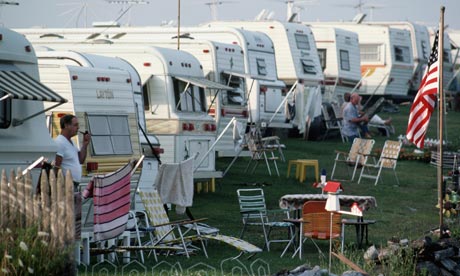
      When buyers purchase an Airstream they're not just buying a vehicle they're buying into a lifestyle.  More than just a trailer, Wally Byam created the entire culture of trailer travel.  "Airstream fans always have one foot reaching for the open road."  The trailer was marketed as a way for buyers to travel all around America and the world while taking their own accommodation with them.  After over seventy years that fact haven't changed but today it has also become about owning a piece of American history and nostalgia.  In many Airstream trailer parks one would often find many of the 50-year-old vintage Airstream models that are still used today parked right along side the brand new 2012 editions. Airstreamer enthusiasts often spends most days from Spring to Fall on the road, going from place to place and meeting up with fellow Airstreamers to form their own little temporary communities.  "There's no point in owning one of the campers and not being part of the community."


Sources:
Schleis, Paula. "Airstream - and its fans - going strong at 80." Cape Cod Times. Cape Cod Times, August 17, 2012.
      Web. 7 Dec 2012. <http://http://www.capecodonline.com/apps/pbcs.dll/article?AID=/20120817/LIFE/208170309>

The Interstate's Impact on the Clipper

      The booming popularity of the Airstream Clipper following WWII can easily be attributed to the creation of the Interstate Highway System in the United States. The Airstream Clipper had been popular since its conception in 1936, but it wasn’t until 1948 that the demand for the trailer shot up tremendously. The Airstream Company was forced to relocate their facilities to a larger factory in Jackson Center, Ohio in order to meet their customers’ needs.


      With a total length of 75 932 km, the Interstate is truly an impressive work of engineering that spans across and connects all of the United States. Before this expansive network existed, the most preferred method of travelling across the country was the transcontinental railway. Not only did the introduction of the Interstate shift the American population from the railway to the road, but it also revolutionized the idea of travelling. Now that the entire country was connected by this network of roads, traveling destinations were no longer limited to the urban areas around train stations. You could essentially travel wherever you wanted (provided it was accessible by the 75 932 km highway system), and you could do all of this within the comfort of your own (second and temporary) home.


      Airstreams were very much designed to travel on the highway. They were never intended to remain stationary in any one place. Rather, just as Wally had intended when he designed the trailer in 1936, the Airstream was meant to be a traveling home for the adventurous highway driver.

After all:

“Why the name ‘Airstream’? Because it rode along the highway, ‘like a stream of air’”
                                                                                                                 
                                                                                                                                       - Bryan Burkhart and David Hunt (Airstream, p. 34)


Sources:
Burkhart, Bryan, and David Hunt. Airstream: The History of the Land Yacht. San Francisco: Chronicle, 2000. Print.
"The Economic Impact of the Interstate Highway System." Interstate 50 Years. Ed. Andrew C. Lemer. N.P., 2006. Web.
      9 Dec. 2012
"History." Airstream, Inc. Airstream, Inc., n.d. Web. 14 Nov 2012. <http://www.airstream.com/company/history/>


"Historical Airstream: Building Dreams is our Business"

Saturday, 8 December 2012

Airstream Hotel

The Grand Daddy Penthouse Trailer Park

     The iconic Airstream travel trailers has recently been appearing all around the world in many hotels and motels as trendy alternatives to the standard hotel room.  Aside from its popularity the efficient use of space, multiple beds, and fully equipped kitchen makes it both cheap and functional.  One of the earliest adapter of this trend was The Shady Dell Trailer Court in Bisbee, AZ who opened in 2007 and carries nine fully restored vintage Airstream trailers for rent.  Another Airstream Hotel attraction is the Grand Daddy hotel in Cape Town, South Africa.  Owner Jody Aufrichtig had spent millions of dollars buying and restoring a fleet of Airstreams to put on the roof of the Grand Daddy to create what he calles the Penthouse Trailer Park. 


Sources:
Catchpole, Karen. "World's Trendiest Airstream Hotels." Travel + Leisure. Travel + Leisure, July 2009. Web. 5 Dec
      2012. <http://www.travelandleisure.com/articles/worlds-trendiest-airstream-hotels#>.

Airstream: A Way of Life

      Since 1936, Airstream has become not just an icon but also a way of life. Spurning its own Airstream-exclusive trailer parks, cult-like followings, and even it's own magazine entitled "Airstream Life", owning an Airstream has become more than just owning a mobile home.


Wednesday, 5 December 2012

Wally Byam Caravan Club International

Although most Airstream owners are passionate travellers many of them were intimidated by the idea of travelling alone.  Wally had noticed that many of the buyers were just letting their trailers sit in the front yard and decided to round up a group of fellow Airstreamers for a caravan.  The first Airstream caravan left in 1951 and travelled to many parts of Central America including Guatemala, El Salvador, Mexico, Honduras and more.  The group eventually grew into the "Wally Byam Caravan Club Internation" (WBCCI) and became one of the largest RV owners club in the world.  At one point the club had became so popular that Wally had to limit the amount of participants to only Airstream owners.

The WBCCI first began touring most of North and Central America and eventually all around the world.  The famous Cape Town to Cairo Caravan began in 1959 in Africa and had included over a hundred participants.  Caravaner enthusiasts gathered from all over on this excursion to see the pyramids and deserts of Central and Northern Africa.  And in 1964 the club set out for Singapore, tracing the silk route originally taken by Marco Polo and travelled 35 000 miles in over a year and visited almost every country in Southern Asian, Europe, and the Soviet Union.


Soon the Airstream became one of the most internationally recognized trailers in the world, spotted in many famous sites and photographs from all around the world.  After Wally's death in 1962 the WBCCI continued and grew to be one of today's leading caravans in Northern and Central America.


Sources:
"Fast Facts." Airstream, Inc. Airstream, Inc., n.d. Web. 14 Nov 2012. <http://www.airstream.com/comp
      any/fast-facts/>
"History." Airstream, Inc. Airstream, Inc., n.d. Web. 14 Nov 2012. <http://www.airstream.com/company
      /history/>
Reasons, Don. "The Airstream Web Ring." The Airstream Web Ring, n.p., n.d. Web. 14 Nov 2012. 
      <http://sd2cx1.webring.org/l/rd?ring=airstream;id=50;url=http%3A%2F%2Fwww%2Ecalldon%2Ec
      om%2Fair%2Ehtm>