Showing posts with label railways. Show all posts

Sunday, 9 December 2012

The Interstate's Impact on the Clipper

      The booming popularity of the Airstream Clipper following WWII can easily be attributed to the creation of the Interstate Highway System in the United States. The Airstream Clipper had been popular since its conception in 1936, but it wasn’t until 1948 that the demand for the trailer shot up tremendously. The Airstream Company was forced to relocate their facilities to a larger factory in Jackson Center, Ohio in order to meet their customers’ needs.


      With a total length of 75 932 km, the Interstate is truly an impressive work of engineering that spans across and connects all of the United States. Before this expansive network existed, the most preferred method of travelling across the country was the transcontinental railway. Not only did the introduction of the Interstate shift the American population from the railway to the road, but it also revolutionized the idea of travelling. Now that the entire country was connected by this network of roads, traveling destinations were no longer limited to the urban areas around train stations. You could essentially travel wherever you wanted (provided it was accessible by the 75 932 km highway system), and you could do all of this within the comfort of your own (second and temporary) home.


      Airstreams were very much designed to travel on the highway. They were never intended to remain stationary in any one place. Rather, just as Wally had intended when he designed the trailer in 1936, the Airstream was meant to be a traveling home for the adventurous highway driver.

After all:

“Why the name ‘Airstream’? Because it rode along the highway, ‘like a stream of air’”
                                                                                                                 
                                                                                                                                       - Bryan Burkhart and David Hunt (Airstream, p. 34)


Sources:
Burkhart, Bryan, and David Hunt. Airstream: The History of the Land Yacht. San Francisco: Chronicle, 2000. Print.
"The Economic Impact of the Interstate Highway System." Interstate 50 Years. Ed. Andrew C. Lemer. N.P., 2006. Web.
      9 Dec. 2012
"History." Airstream, Inc. Airstream, Inc., n.d. Web. 14 Nov 2012. <http://www.airstream.com/company/history/>


Saturday, 8 December 2012

From Trains to Trailers

      Up until WWII, trains had been the most popular mode of transportation within the United States. Railways that ran directly from station to station transported freight and passengers to and from city centers. Prior to the 1950s, nearly everyone lived along a railway, if not within the vicinity of a railway station – consequently, this method of travel worked exceptionally well for the needs of that era. During WWII, passenger rail even reached its all-time peak of 98 billion passenger-miles (the sum of all the miles travelled by each individual passenger) when there was a gasoline and tire rationing.  Much like Airstream owners, passengers could transform their respective train compartments into dwellings for the duration of the train trip. Why is it, then, that railway transportation saw a sudden decline in the 1950s following the World War?


      To put it simply, the Interstate Highway System.  Once the Interstate was formed, most Americans took to the roads instead. The highways allowed for something that the railway tracks didn’t: freedom. While the railways ran along strict routes strung between several of stations scattered across the country, highways provided for the privacy and mobility to venture throughout the country alone. Suddenly, everyone had the option to travel long distances whenever and wherever they wanted, provided that they had an automobile.  While there were endless debates regarding the cost differences between the two modes of transportation, it really all came down to which provided a greater ease of mobility. Traveling on the Interstates had become a symbol of the American dream of individual liberty. Along with religion, speech, press, assembly, and petition, 'toll-free' travel virtually became America's 'Sixth Freedom'. Quite evidently, the car was ruled out as the victor. When both the schedule and destination of a trip could be conveniently determined by the traveler, passenger trains had a hard time maintaining their dominance over motorized vehicles. 

"Whether we like it or not, any fool can see that this Earth is gradually becoming one world. Nobody knows what the form of the 'one' will be, but it's going to be one or none."

                                                                                                              - Wally Byam, 1960


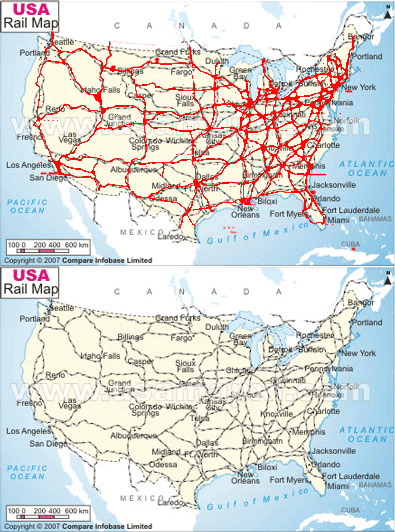
An overlay of the interstate system on the railway system. It becomes apparent that while the major highways parallel the railway routes, the highways offer more mobility and freedom to travel in different ways.


Sources:
"The Economic Impact of the Interstate Highway System." Interstate 50 Years. Ed. Andrew C. Lemer. N.P., 2006. Web.
      8 Dec. 2012
McCrary, Lewis. "A Nation Derailed." The American Conservative. N.P., 3 Aug 2011. Web. 3 Dec. 2012. <http://www.
      theamericanconservative.com/articles/a-nation-derailed.>.