

Wally Byam's Airstream Clipper; A case study
Tuesday, 11 December 2012

Tidbit #3
The Airstream's aluminum exterior and design of its shape is based on the airplane fuselage and the rounded corners increases gas mileage and cuts drag by 20 percent compared to the standard square trailers.
Sources:
"Fast Facts." Airstream, Inc. Airstream, Inc., n.d. Web. 14 Nov 2012. <http://www.airstream.com/comp
any/fast-facts/>
Tidbit #2

Airstream Production
Sources:
"Fast Facts." Airstream, Inc. Airstream, Inc., n.d. Web. 14 Nov 2012. <http://www.airstream.com/comp
any/fast-facts/>
Tidbit #1

Wally Byam wearing his blue beret
During the Caravan trips Wally's choice of headgear had been a blue beret which he had acquired from France. This was quickly adopted by many other caravan members and became a way of recognizing each other in crowds.
Sources:
"Fast Facts." Airstream, Inc. Airstream, Inc., n.d. Web. 14 Nov 2012. <http://www.airstream.com/comp
any/fast-facts/>
Wally Byam's Travel Philosophy
"Adventure is where you find it, any place, every place, except at home in the rocking chair" - Wally Byam

Wally Byam believed in adventure. He believed that the trailer should be used as a mode of transportation and travel rather than a stationary home. He believed that everyone - even those who hated to leave home - should tap into their sense of adventure and go out onto the highway in search of new experiences. His dream for the Airstream Company was to create a lifestyle in which people could do so without leaving the comforts of their home. In fact, he didn't think that anyone should ever stop traveling, so long as they were physically capable of it. Wally believed that there was something to be found and to be seen anywhere in the world, even in places that weren't too far from home at all. When asked by one of the caravanners what they should do while he's in the hospital, he said:
"Don't stop. Keep right on going. Hitch up your trailer and go to Canada or down to Old Mexico. Head for Europe, if you can afford it, or go to the Mardi Gras. Go someplace you've heard about, where you can fish or hunt or collect rocks or just look up at the sky. Find out what's at the end of some country road. Go see what's over the next hill, and the one after that, and the one after that."

To Wally, trailer travel provided their owners with freedom - four freedoms, to be exact, that he laid out in Trailer Travel.
"To place the great wild world at your doorstep, for you who yearn to travel with all the comforts of home"
- Wally Byam

Wally Byam believed in adventure. He believed that the trailer should be used as a mode of transportation and travel rather than a stationary home. He believed that everyone - even those who hated to leave home - should tap into their sense of adventure and go out onto the highway in search of new experiences. His dream for the Airstream Company was to create a lifestyle in which people could do so without leaving the comforts of their home. In fact, he didn't think that anyone should ever stop traveling, so long as they were physically capable of it. Wally believed that there was something to be found and to be seen anywhere in the world, even in places that weren't too far from home at all. When asked by one of the caravanners what they should do while he's in the hospital, he said:
"Don't stop. Keep right on going. Hitch up your trailer and go to Canada or down to Old Mexico. Head for Europe, if you can afford it, or go to the Mardi Gras. Go someplace you've heard about, where you can fish or hunt or collect rocks or just look up at the sky. Find out what's at the end of some country road. Go see what's over the next hill, and the one after that, and the one after that."

To Wally, trailer travel provided their owners with freedom - four freedoms, to be exact, that he laid out in Trailer Travel.
- Freedom from arrangements - reservations, schedules, taxis, tips. "You don't have to worry about reservations in the next town or where you are going to sleep that night. You have all your accommodations right there with you. Home is where you stop."
- Freedom from the problems of age - "For some, checkers, clubs, gardening, and grandchildren is not enough. Out of this boredom, ailments are born."
- Freedom to know - "You meet people on a train or a plane and the next day you separate. When you travel in a trailer, you meet people in their homes and they meet you in theirs."
- Freedom for fun - "To relax and lose yourself mentally."
"To place the great wild world at your doorstep, for you who yearn to travel with all the comforts of home"
- Wally Byam
Sources:
Burkhart, Bryan, and David Hunt. Airstream: The History of the Land Yacht. San Francisco: Chronicle, 2000. Print.

The Trailer as a Permanent Address
Over the years, Wally’s idealistic vision of the Airstream
as a traveling home has been buried under the negative views portrayed by
popular culture. Today, the term ‘trailer’ conjures up a variety of images,
none of which are – unfortunately – related to the iconic Clipper or any of
Wally Byam’s Airstream legacies. All of these connotations were initiated by
the idea of transforming one’s mobile home into a primary home – in other
words, a permanent address. As the movement continued to grow, the picture of
freedom and mobility that once surrounded the Airstream was steadily replaced
by a string of stereotypes that branded trailer-dwellers as ‘rootless hobos’
and ‘homeless gypsies’.


“Small men, most of them, mousetrap makers startled by the
customers banging at their doors, they have no exalted ideas about converting
homeowners to nomadism…They want the trailer to be a vehicle, not a permanent
address”
-
Fortune Magazine [about Wally Byam]
Wally had never intended for his trailers to become
permanent addresses. In fact, despite the potential he saw for sales amongst
people like cotton pickers, wheat harvesters, mechanics and factory workers who
migrated from job to job, he highly discouraged the notion of ‘living’ in a
trailer. Nevertheless, many war-time couples who wed during the war turned to
Airstream Clippers for temporary housing. Moreover, a surplus of university
students was housed in the Clippers when no other residences could be found to
accommodate them. It seemed that Wally’s voice in the issue was quickly
overcome by the demand for affordable and mobile housing.
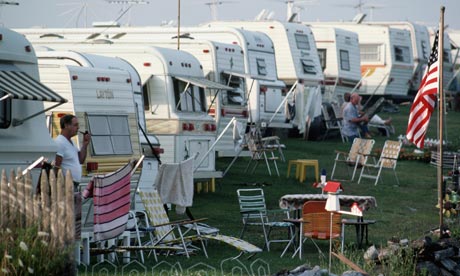
Most trailers in the 1930s provided all that was necessary
in a home – a small toilet, a kitchen, a bed, etc. However, people still needed
a place to stop and rest at the end of the day. Consequently, gas station
owners would wait for tired trailer owners and charge them 25 cents a day to
plug into their electricity and have access to tap water. In this way, the
first informal trailer parks were born. Some people simply never got back on
the road. For others, not having a permanent address was a clever way of
evading tax collectors and landlords. Most impressively, living in a trailer
cost only $65 a month. Public opinion quickly turned against these trailer
parks; many people were distrustful of them and believed that they would cause
a great menace within the justice system with all the new laws that would have
to be created for their regulation.

Wally Byam was aware of the buzz that surrounded his beloved
creation. He once said, “We are determined to improve our public image, as the
boys on Madison Avenue say, so that people change their absurd notion that we
are homeless gypsies.” Unfortunately, the negative associations with trailers
have only worsened since his death. Wally’s picture-perfect vision of a traveling
home never returned to the popularity it experienced when the Clipper was first
introduced.
Sources:
Easterling, Keller. Organization Space: Landscapes, Highways, and Houses in America. Cambridge, MA:MIT, 1999.
Print.
Print.
Subscribe to:
Posts (Atom)